30 March 2010

Eco Easter holiday & sticky chocolate news

Going on an Eco Easter adventure?  Don't forget to...

Switch off the hot water system before going away - you could be wasting energy and money keeping water hot when you're not there.

Service your car before a long trip and check your tyre pressure. A tuned up car improves fuel efficiency by up to 30% and will save you petrol money. 

Take your reusable shopping bags on the grocery supplies trip.

Recycle bottles, cans, cardboard and plastic packaging.  Please call your local Council to check which types of plastic packaging they will accept - many will accept the firm plastic that easter eggs are packaged in.

Encourage kids at home to switch off their game consoles, DVD player, TV and stereo at the wall when not in use.

Purchase Easter gifts with the least amount of packaging and choose certified Free Trade and organic chocolate and easter eggs.

References http://www.climatesmart.qld.gov.au/

What to take?

Eco friendly picnic, catering and entertaining supplies, reusable water bottlestainless steel cup set, BPA-free lunch boxes for storing food.

Petrochemical free natural sunscreen, environment-safe shampoo and soap (especially camping in National Parks).

Natural mosquito repellant and New Mountain sandalwood mosquito diffuser, flies off food nets.

Sticky chocolate issues

Will Nestle ever reclaim its Facebook page from palm oil protestors  Is this the most successful social-media influence campaign ever...?

Treehugger reports on the wasteful excess of Easter Egg packaging and improvements to eliminate plastic boxes.  Easter Candy Insanity...

Australian Fair Trade Easter 2010 Campaign website.  Learn more about the issues and the choices you can make.

23 March 2010

Compost and animal friends love watermelon skin

We had some great suggestions from Biome Facebook fans on what to do with our watermelon rind waste.

Horses and dogs love to eat watermelon skin, along with chickens - who not only love to eat it, but they turn it into eggs as well!


And, composting of course.  Environmentalist David Suzuki says you will reduce greenhouse gas emissions by composting your household waste rather than sending it to landfill.  He says that in Canada “landfills produce the greenhouse equivalent of five million cars”. 


When food, garden waste, nappies, paper and cardboard are disposed of in landfill they decompose anaerobically (without air) and produce methane—which is 21 times more potent as a greenhouse gas than carbon-dioxide. However, the composting process at home does not contribute to methane generation because it takes place close to the surface and oxygen.


The Bokashi composting system is popular for its convenience and because it produces a rich soil fertiliser that does wonders for your plants.  Bokashi microbes "ferment" the scraps without smells, so you can keep the bucket under your sink or in your home.

19 March 2010

Waste diary & BBQ watermelon rind challenge

In the spirit of our waste diary challenge posted last week I undertook a "fridge cleansing", which purged a lot more waste than we normally would generate.  It was time to confront all those disposal dilemnas that I hide away at the back of the fridge.

The fridge clear-out put my compulsion for hoarding relishes and condiments under a harsh spotlight.  So many that I could not recall how long they had been there and that I could no longer face eating.  Getting rid of the contents and rinsing the jars can use a lot of precious water, but we are told by the Council that containers and jars must be clean-ish before putting them into recycling.

Our waste from meal preparation was minimal, just avocado skins, seeds, carrot peelings and the like.  I snuck the end slices of the tomatoes onto sandwiches - breaking my silly habit of throwing out the ends.  Instead of wasting the crusts on the end of bread, I put them in the freezer to use for breadcrumbs later. That tactic does however have a limited life span, as there are few uses for breadcrumbs in my cooking repertoire!


This photo from The Guardian by Tristram Stuart shows three identical Romaine lettuces purchased at the same time and stored for ten days, from left to right 1) at room temperature 2) in the fridge and 3) in a glass of water like cut flowers.  Inspired, I kept herbs in water (refreshed daily) and they stayed fresh much longer. 

Our biggest volume of waste was watermelon rind!  Apparently the white flesh and green skin is used as a vegetable in many Asian countries and contains great vitamins, minerals, fibre and antioxidants.

I love that you can so easily find recipes on the internet for weird and wonderful ingredients, like:
Watermelon Skin Halwa
Barbequed Watermelon Rind with Sauces
Watermelon Pie from southern USA

Someone has even dedicated a whole site to fill your belly, not landfill with watermelon

The challenge now is to give them a go.  BBQ watermelon rind first...

12 March 2010

Livia Firth promotes sustainable fashion at Oscars

Photo from Vogue.com

Livia Giuggioli, Italian film producer and wife of Colin Firth, writes a blog for Vouge.com "The Green Carpet Challenge".  If you have an interest in sustainable fashion, Livia shares great information about how she dressed for the film awards season and some of the ethical and environmental issues related to fashion.  To the Oscars she wore ethical Australian pink Argyle Diamonds by Calleija Jewellers.

One issue she highlights is the deceptive labelling and marketing of bamboo fabric.  She points to this article by the US Federal Trade Commission  Have you been bamboozled by bamboo fabric? .  This is taken from the article:
Looking to be a more environmentally conscious shopper? You’ve probably heard about bamboo. Bamboo stands out for its ability to grow quickly with little or no need for pesticides, and it is used in a variety of products, from flooring to furniture. But when it comes to soft bamboo textiles, like shirts or sheets, there’s a catch: they’re actually rayon.

The Federal Trade Commission, the nation’s consumer protection agency, wants you to know that the soft “bamboo” fabrics on the market today are rayon. They are made using toxic chemicals in a process that releases pollutants into the air. Extracting bamboo fibers is expensive and time-consuming, and textiles made just from bamboo fiber don’t feel silky smooth.
There’s also no evidence that rayon made from bamboo retains the antimicrobial properties of the bamboo plant, as some sellers and manufacturers claim. Even when bamboo is the “plant source” used to create rayon, no traits of the original plant are left in the finished product.
Companies that claim a product is “bamboo” should have reliable evidence, like scientific tests and analyses, to show that it’s made of actual bamboo fiber.

07 March 2010

Lunch boxes wrap up on what's eco and safe

Would you agree that the most eco-friendly solution usually turns out to be the best choice for your health and your budget also?  We find that making the safest choice for the planet is the safer path for people too, particularly when it comes to natural skin care, green cleaning and petrochemical plastic products.

With a simple decision on lunch boxes and how to pack a lunch, you can: help the planet by opting for long lasting and resource-efficient materials, reduce waste going to landfill, protect your health by avoiding toxic plastics, and save a little cash by reusing and buying in bulk.

Many Australian schools are trying to reduce rubbish by encouraging children to take home food scraps, use composting at school and use less plastic wraps.  Our family is fortunate to live very close to our school, but not so fortunate to be woken at dawn each morning by the clean up crew--the crows!  So there may even be an extra benefit for us from a waste-free lunch policy...a sleep in.

One of the nasties to avoid when choosing a lunch box, is Polyvinyl Chloride (PVC) - recognised by this symbol.  Often on a soft shiny plastic lunch box (often the grey plastic inside) there is no label to tell you what it is, but it is more than likely PVC that can contain lead and phthalates.
According to the Center for Health, Environment & Justice (CHEJ): "PVC is unique among plastics because it contains dangerous chemical additives used to soften it.  These harmful chemicals include phthalates, lead, cadmium and organotins, which can be toxic to a child's health.  Over 90% of all phthalates are used in PVC products such as school supplies.  Federal (US) law has banned the use of phthalates in children's toys, but not children's school supplies.  Lunch boxes, binders, vinyl backpacks and art supplies are frequently made out of PVC."

"Children are particularly vulnerable to the harmful effects of toxic chemicals used in PVC.  Recent studies have linked PVC flooring to increased rates of autism and asthma.  Chemicals that evaporate or leech out of PVC products may contribute to developmental disorders and damage to the liver, central nervous, respiratory and reproductive systems." 

Further, many environmental groups are calling for the banning of PVC because it releases dioxins during manufacturing and when it is burned, recycled or or disposed of in landfill.  Both Wikipedia and CHEJ detail the dangers, including how highly toxic dioxins have been found to cause cancer in workers manufacturing PVC. 

How to identify products with PVC
  • Labelled with the word “vinyl” (e.g. vinyl ring binders)
  • #3 recycling symbol or with the letters “V” or “PVC” underneath the recycling symbol
  • Shiny flexible plastic inside and outside lunch boxes, back packs, clothing (such as raincoats) and waterproof mattress protectors. 
  • Don't buy the product if it is not labelled with the type of plastic or with specific statements that it is lead free and PVC free.
  • Contact the manufacturer or retailer to ask what plastic the product is made of.
Choose lunch boxes and school products made from metal such as stainless steel, fabric, sustainable wood, recycled paper and safe plastics that are PVC free, BPA free and lead free.  Polypropylene is also a safe choice.
    Biome has just introduced the exciting Kids Konserve waste-free lunch range (pictured above): Food Kozy sandwich wrap, insulated lunch bag made from recycled PET bottles, stainless steel food container, ice pack and more. 
    Biome also offers:
    Goodbyn all-in-one lunchboxes with cool stickers
    LunchBots stainless steel lunch boxes
    4myearth sandwich wraps
    Thermos
    Klean Kanteen insulated wide mouth bottles
    Bento boxes

    04 March 2010

    Freegans waste not - will you keep a waste diary?

    Thank you to the simple living blog Little Eco Footprints for the inspiration for this post.  I love reading about your actions, especially your latest post Saved from the bin where you mentioned the Australian food rescue organisations that save food before it makes it into the bin - Oz Harvest, Foodbank, FareShare, SecondBite. Amazing that blog author, Tricia, then saw an Oz Harvest van pulling up at the Aldi Supermarket across the road from her - that was karma!

    It's a topic that can make you feel so powerless on the world scale, but what really matters is each of our individual households.   Apparently, we throw out about one quarter of the food we buy.  That can't be hard to change.

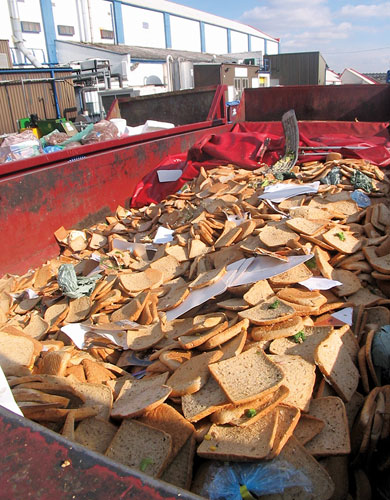
    The Guardian in the UK has an insightful feature on 'Freegans' and food waste. This article profiles Freegan campaigner Tristram Stuart and this is an eye-opening photo gallery of foods that are thrown away by stores or left to rot. The below photo shows the result of Marks & Spencer's requirement for its sandwich supplier to discard four slices from each loaf: the crusts and the first slice at either end.  This means 13,000 slices of fresh bread are discarded every day from a single factory...


    How much do you throw away in one week?
     
    The Guardian asked three people to record what they threw away in one week. I am going to try to keep a diary this week and report back.  That is scary, but it is incentive to be careful about what we buy.   Would anyone else like to keep a record and share it with us in a week or so?